
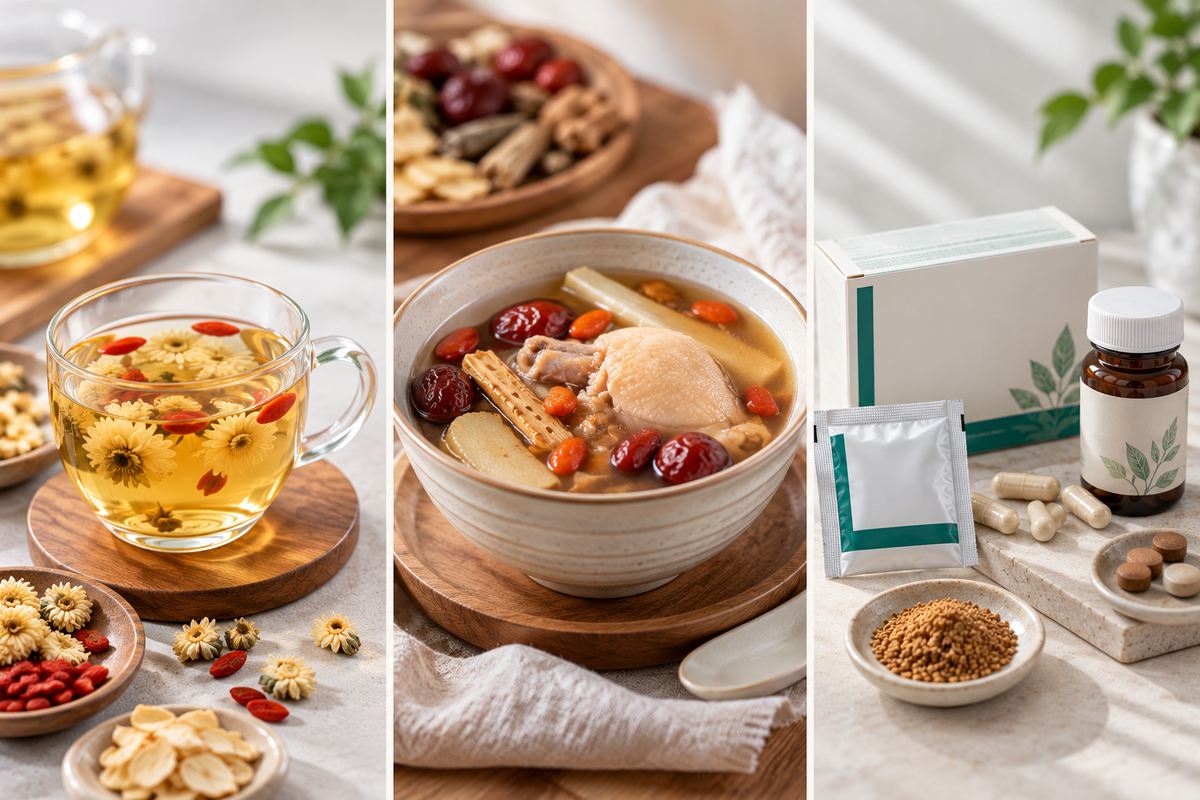
Traditional Chinese Medicine (TCM) has long been part of everyday life in Singapore. From drinking herbal tea (凉茶) on a hot day to preparing nourishing herbal soups (药膳汤) at home, many of us are familiar with using traditional herbs for health and wellness.
We may also have taken Chinese herbal medicines, such as cough remedies, herbal granules or capsules, when feeling unwell.
But have you ever wondered: What is the difference between herbal tea, herbal soup and proprietary Chinese medicine? Are they interchangeable, and how do we know which one to choose?
Although all three may contain traditional Chinese herbs, they differ in their purpose, preparation, ingredients, regulation and how they should be used.
1. TCM Herbal Tea (凉茶 / 养生茶)

Despite the name, herbal teas do not necessarily contain tea leaves. They are usually prepared by steeping or boiling herbs, flowers, fruits or other plant ingredients in water.
In TCM, different herbal teas are traditionally used for different purposes. For example:
-
Chrysanthemum tea (菊花茶): Traditionally used to disperse wind-heat and support relief of certain heat-related symptoms.
-
Luo han guo tea (罗汉果茶): Traditionally used to moisten the lungs and soothe the throat.
-
Hawthorn tea (山楂茶): Traditionally used to support digestion, particularly after heavy meals.
-
Red date and goji berry tea (红枣枸杞茶): Commonly enjoyed as an everyday wellness beverage.
However, not all herbal teas are suitable for everyone.
For example, some liang cha formulations contain herbs traditionally classified as cold or heat-clearing. Drinking them frequently may not be suitable for individuals who tend to experience loose stools, abdominal discomfort or other symptoms associated with a cold pattern in TCM.
It is also important to distinguish between everyday herbal beverages and medicinal herbal teas. Some commercially prepared herbal teas contain medicinal herbs in substantial amounts and should not automatically be treated as harmless daily drinks.
Key takeaway: Herbal teas are often consumed for hydration, enjoyment or general wellness, but their suitability depends on the ingredients, preparation and individual health condition.
2. TCM Herbal Soup (药膳汤)

Unlike herbal teas, herbal soups usually combine traditional herbs with food ingredients such as chicken, pork ribs, fish, vegetables or mushrooms.
This reflects the traditional TCM concept of 药食同源 (food and medicine sharing common origins), where certain ingredients are used both in cooking and in traditional health practices.
Common ingredients found in herbal soups include:
-
Chinese yam (山药): Traditionally associated with supporting the spleen and stomach.
-
Lotus seeds (莲子): Traditionally used to support the spleen and nourish the heart.
-
Red dates (红枣): Traditionally used to tonify the spleen and nourish blood.
-
Goji berries (枸杞子): Traditionally used to nourish the liver and kidneys.
-
Astragalus root (黄芪): A medicinal herb traditionally used to tonify qi, sometimes included in tonic soups.
Herbal soups are commonly prepared as part of regular meals and are often associated with nourishment, recovery and general well-being.
However, not every herbal soup is suitable for daily consumption.
A simple soup containing Chinese yam, lotus seeds and lean meat is different from a strongly formulated medicinal soup containing multiple tonic herbs.
The latter may have more specific traditional therapeutic intentions and may not be suitable for certain individuals, particularly those who are pregnant, taking medications or managing chronic medical conditions.
Another common misconception is that herbal soups are always beneficial because they are natural and homemade. In reality, the choice of herbs, quantity, preparation method and frequency of consumption all matter.
Key takeaway: Herbal soups combine food and traditional herbs, primarily for nourishment and dietary wellness. They are not necessarily a substitute for medical treatment.
3. Proprietary Chinese Medicine (中成药)

Proprietary Chinese medicines (PCMs), commonly known as 中成药, are prepared Chinese medicinal products manufactured according to established formulations.
Unlike homemade herbal teas or soups, PCMs are generally produced in standardised dosage forms, such as tablets, capsules, pills, powders, granules or oral liquids.
Some familiar examples include:
-
Yin Qiao San (银翘散): Traditionally used for certain wind-heat presentations.
-
Bao Ji Wan (保济丸): Traditionally used for certain digestive complaints.
-
Liu Wei Di Huang Wan (六味地黄丸): Traditionally used for specific kidney-yin deficiency patterns.
-
Chuan Bei Pi Pa Gao (川贝枇杷膏): A traditional preparation used for certain cough and throat symptoms.
Unlike general wellness beverages, these products are intended for specific medicinal purposes.
Does having the same symptom mean taking the same medicine?
Not necessarily.
In TCM, treatment selection depends not only on the symptom (症) but also on the underlying pattern/syndrome (证), known as 辨证论治 (syndrome differentiation and treatment).
For example, two individuals may both experience a cough, but their symptoms may differ:
One person may have a dry cough, dry throat and little phlegm, while another may have a cough with abundant white phlegm and a sensation of cold.
From a TCM perspective, these may represent different syndromes requiring different treatment approaches.
Taking the wrong medicine may not address the underlying condition and could potentially cause unwanted effects.
Are proprietary Chinese medicines regulated in Singapore?
Yes. In Singapore, proprietary Chinese medicines are regulated by the Health Sciences Authority (HSA).
Products supplied locally must meet applicable requirements, including those relating to ingredients, safety, quality and labelling. Importers and wholesalers are subject to licensing requirements, and products must be listed with HSA before local supply.
However, an important distinction is that HSA listing does not mean that the medicine has been evaluated or approved for clinical effectiveness in the same way as a conventional registered therapeutic drug.
Consumers should purchase from reliable sources, check product information and follow the labelled instructions.
Key takeaway: Proprietary Chinese medicines are manufactured medicinal preparations intended for particular uses. They should be selected according to the individual's symptoms, TCM pattern and relevant safety considerations.
4. At a Glance: What Are the Main Differences?
|
Herbal Tea (凉茶 / 养生茶) |
Herbal Soup (药膳汤) |
Proprietary Chinese Medicine (中成药) |
|
|---|---|---|---|
|
Main purpose |
Beverage, general wellness or traditional symptom relief |
Nutrition, nourishment and dietary wellness |
Specific medicinal purposes |
|
Preparation |
Steeping or boiling herbs in water |
Cooking herbs with food ingredients |
Manufactured medicinal formulations |
|
Common forms |
Tea, herbal drinks, decoctions |
Soups and broths |
Pills, capsules, tablets, granules, liquids |
|
Ingredients |
Flowers, fruits and herbs |
Food ingredients and herbs |
Defined combinations of medicinal ingredients |
|
Dosage |
Varies by recipe or product |
Varies by recipe and portion |
Follow product instructions or professional advice |
|
Frequency |
Depends on ingredients |
Depends on ingredients |
Depends on medicine and indication |
|
Safety considerations |
Some herbs may be unsuitable for regular use |
Tonic herbs may not suit everyone |
Contraindications, interactions and adverse effects |
|
Singapore regulation |
Depends on product classification |
Generally food regulations when sold as food |
HSA requirements for PCMs |
Note: These are general distinctions, not strict regulatory categories. A preparation marketed as herbal tea or soup may be classified differently depending on its ingredients, presentation and intended use.
5. Can Herbal Tea, Herbal Soup and Chinese Medicine Be Taken Together?
Many people assume that herbal teas and soups are simply food and therefore cannot interfere with medicines.
However, this is not always true.
Certain herbs may appear in more than one preparation. For example, someone may consume a tonic herbal soup while also taking Chinese herbal medicine containing similar ingredients.
This may increase their overall exposure to particular herbs.
Some herbs may also interact with prescription medicines, and certain combinations may be unsuitable for individuals with existing health conditions.
If you are taking regular medication, are pregnant or breastfeeding, or have liver or kidney disease, it is advisable to check with an appropriately qualified healthcare professional before using medicinal herbal products.
More is not necessarily better when it comes to traditional herbs.
6. So, Which One Should You Choose?
The choice depends on your purpose.
For someone who simply enjoys a warm, caffeine-free beverage, a mild herbal tea made from suitable food ingredients may be sufficient.
For someone looking to incorporate traditional nourishment into family meals, a thoughtfully prepared herbal soup may be an option.
For someone experiencing symptoms such as cough, digestive discomfort or other health concerns, a proprietary Chinese medicine may be considered when appropriate, but the formulation needs to match the individual's condition.
And if symptoms are persistent, recurrent, severe or unexplained, it is important to seek proper medical assessment rather than relying on self-medication.
7. A TCM Perspective: The Right Herb for the Right Person
One of the key principles of TCM is that there is no single herb or formula that suits everyone.
An ingredient traditionally described as nourishing may be suitable for one individual but inappropriate for another. Similarly, a heat-clearing herbal tea may be useful in certain circumstances but unnecessary for someone without a corresponding pattern.
Understanding the properties of traditional herbs, their intended uses and their limitations can help us make more informed choices.
Whether it is a cup of herbal tea, a bowl of nourishing soup or a proprietary Chinese medicine, the goal should not simply be to consume more herbs, but to choose appropriately and safely.
Making TCM Simple with JIN TCM Remedies
At JIN TCM Clinic, we believe that understanding what we consume is an important part of making informed health decisions.
Through JIN TCM Remedies, we hope to make traditional Chinese medicine easier to understand by sharing practical knowledge about commonly used herbs, proprietary Chinese medicines and everyday wellness.
Explore our selection of traditional Chinese medicinal products and wellness essentials at shop.jintcm.com.
For personalised advice, consult a registered TCM physician to better understand which treatments or herbal preparations may be appropriate for your needs.
Disclaimer: This article is intended for general educational purposes and does not replace professional medical advice, diagnosis or treatment. Traditional uses described in this article do not necessarily imply clinically proven effectiveness.
Educational content only. This article is not a substitute for personal medical advice. If symptoms persist, book a consultation with one of our MOH-registered physicians.

